Chimpanzees Actively Teach Tool Use to Their Offspring
New research reveals that chimpanzees actively teach tool use to their infants by demonstrating and handing over implements, challenging previous assumptions.
A new study indicates that chimpanzees actively teach their offspring how to use tools, not just through observation, but by directly handing over implements and demonstrating their use. This finding provides significant insights into how tool use is transmitted among primates.
Published in the journal Frontiers in Psychology, the research shows that adult chimpanzees deliberately model tool-using behavior and then transfer the tools to their young so they can mimic the actions. This interactive teaching method facilitates the learning of complex skills.
Highlights
- Chimpanzees actively teach tool use to their infants by demonstrating and transferring tools.
- This behavior was observed particularly during foraging activities like ant-dipping, algae fishing, and termite fishing.
- The study collected nearly 15 hours of video footage from 2017 to 2025 in Senegal's Dindefelo Community Nature Reserve.
- Analysis of the footage identified 33 instances of tool transfer and 3 attempted transfers.
- Most tool transfers (58%) were initiated by adult females, with infants being the primary recipients (42%).
Details
Andreu Sánchez-Megías, a graduate student at the University of Barcelona and the Jane Goodall Institute Spain, suggests that tool transfers may help chimpanzees learn to use technology to extract hard-to-access foods. These transfers are considered a form of teaching, alongside observation and supervised practice. Mothers were observed to be the main models and teachers for young chimpanzees in this process.
Researchers collected observational data from the chimpanzee population at the Dindefelo Community Nature Reserve in Senegal between 2017 and 2025 using camera traps. Approximately 15 hours of video footage were analyzed, documenting 33 instances of tool transfer and 3 attempted transfers. Additionally, 4 instances of proto-tool use, where chimps used stones or hard wood to crack baobab fruits, were recorded.
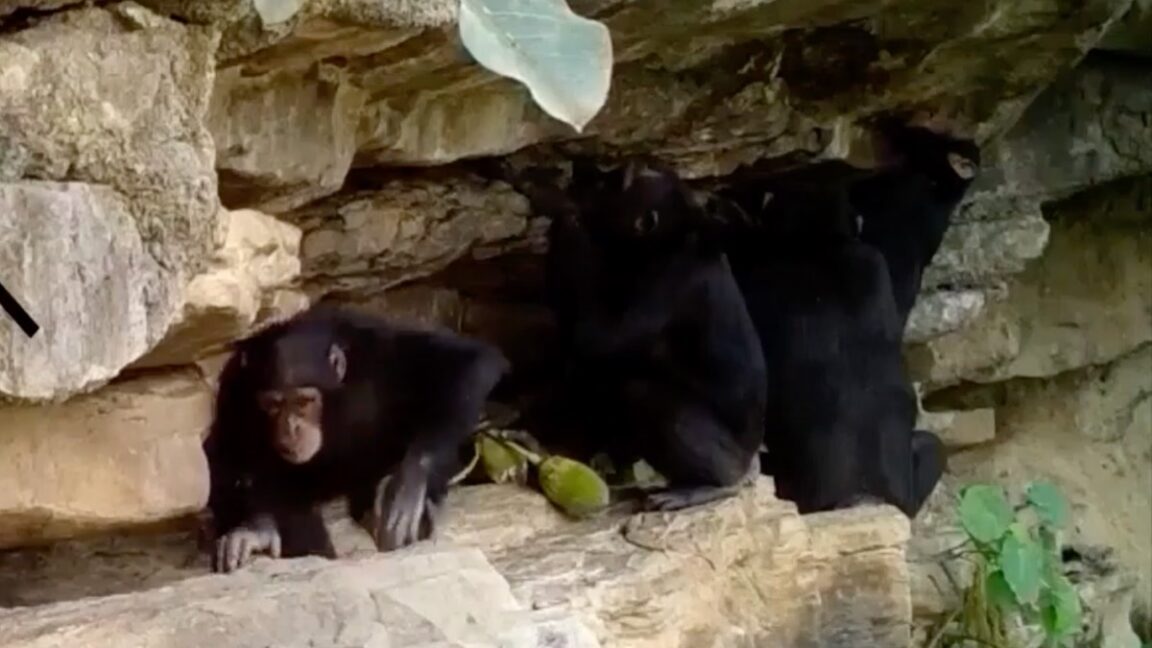
Two specific case studies were highlighted: In the first, an adult female named Soukki dipped a twig into an ant nest and then left it for her infant, Saïsaï, who then mimicked her mother's behavior. In the second, a mother chimp named Féré brought baobab fruits to her infant, Fotti. A juvenile chimp then demonstrated how to break the fruit, guiding Fotti's hand, who successfully repeated the pounding motions to open the fruit.
Why it matters
This study demonstrates the advanced social learning capabilities and teaching capacity of chimpanzees. Proving that teaching behavior, once thought to be unique to humans, also exists in other primates deepens our understanding of cognitive evolution and interspecies learning mechanisms. These findings also offer important clues for understanding the evolutionary origins of tool use.